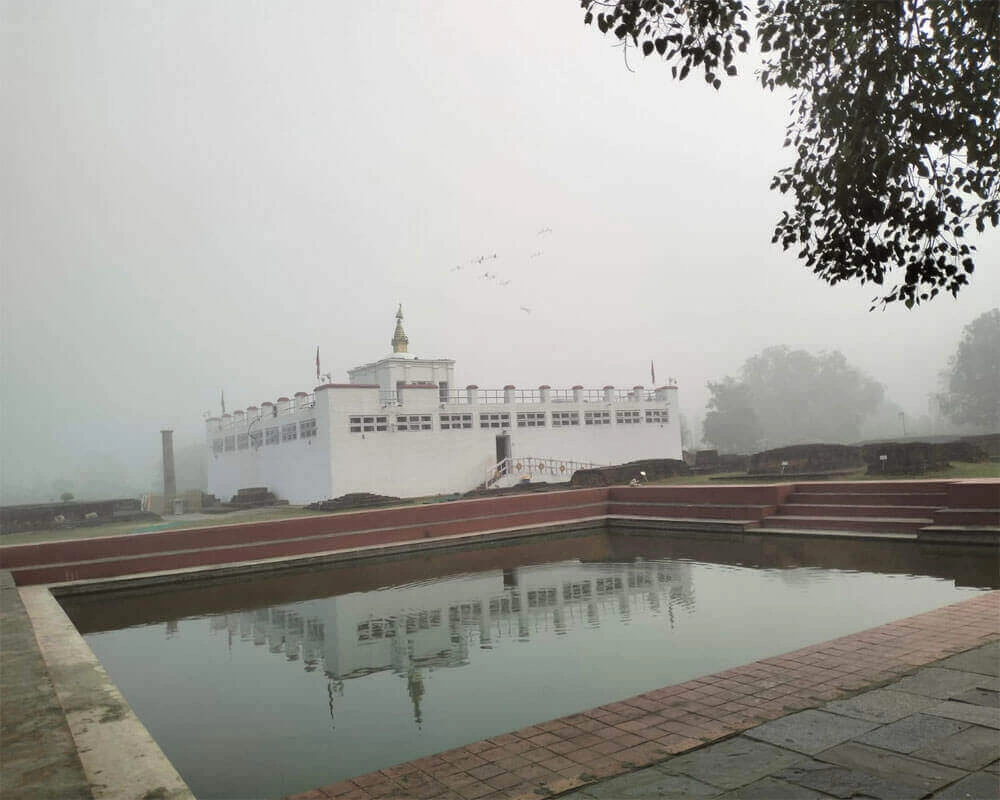
Lumbini Tour Package
Overview
Itinerary
Your journey, day by day
Inclusions & Exclusions
Everything included in your package and what you need to arrange yourself.
- Pick up From Kathmandu Hotel to Airport and Bharawa airport to Lumbini Hotel by Private Car
- Pick up from lumbini hotel to Bharawa airport and kathmandu airport to kathmandu hotel by private car
- Kathmandu to Bhairawa and Bhairawa to Kathmandu by Flight
- Sightseeing in lumbini by guide with entrance ticket
- 3 Star Deluxe Accommodation for 2 Nights
- Every Day Morning Breakfast at Hotel
- All our government taxes, vat, official expenses & service charges
- Five Star Hotel
- Any lunch, dinner, snacks, mineral water etc. unless mentioned in the itinerary.
- Sightseeing in Lumbini
- Monument entrance fees
- Portage, laundry, telephone calls, table drinks or any other expenses of personal nature.
Insurance
Useful Information
Lumbini is low land region of Nepal. Temperature is hot during March to November month. Not to bring heavey bag with clothes. wear light cloth suitable for hot temperature. During June july and August rainy season and suggest to bring an umbrella with you. December to February is cold temperature in Lumbini. Go there with warm clothes.
Extend one day tour in Lumbini and include Kapilabhastu, Gotihawa, Niglihawa and Kudan.
Kapilavastu is the name of the ancient Sakya city “The royal family of Lord Buddha” where Siddhartha Gautama, also known as the Buddha, was raised and lived until the age of 29. At Kapilavastu, the Lord Gautama Buddha was grown up and led a family life with his wife and son till he left for Nirvana. The place is about 25 kilometers east of Lumbini (the birthplace of the Siddhartha Gautama). Shakya capital (Kapilavastu) has a rich history and several stories related to faith and believe are narrated here by the locals. The stories are centuries old. There are many ancient archaeological sites situated in a 10 kilometer circle around.
Kapilvastu Kingdom Complex
Gotihawa lies 5-km southwest of Taulihawa town and is considered the natal town of Krakuchanda Buddha. The place has ruins of ancient habitation, stupas and monasteries. The place was visited by Ashoka as evidenced by a pillar with inscriptions. The pillar is broken with the upper part missing.
Araurakot lies about 9-km northeast of Tilaurakot. P.C. Mukheiji (1899) identified it as the natal town of Kanakmuni Buddha. It is a rectangular fortified area that contains a moat with heaps of ancient ruins.
Kundan is located 2-km southwest of Taulihawa on way to Gotihawa. It is a beautiful protected garden area with large structural ruins of monasteries and stupas and with a tank nearby. This is considered the historical sight where Lord Buddha, returning after many years preached, and where his father, ?uddhodana, was converted to Buddhism.
Niglihawa 7-km northwest of Tilaurakot, was another site visited by Ashoka and marked with a pillar. The pillar is broken into two pieces. The standing base pillar has Ashokan inscription in Brahmi script and the upper pillar has Devanagari inscription marking Ripu Mai's visit in 1312 AD. There are ruins of monasteries, stupas and habitation. It is identified as ancient town of Sobhawati, birthplace of Kanakmuni Buddha.
Sagarhawa lies 3.5 km north of Tilaurakot and west of Banganga river. It is a rectangular depression. Excavations done in 1896 traced seventeen stupas and large monuments made from well-burnt bricks. Findings of casket and other rare antiquities indicate them to be votive stupas of the war dead. However, these stupas remain no more as they were excavated to their foundation without restoration.
(Info from wikitravel.org)
FAQ
Reviews
2 reviews
This is a test
Our honeymoon package with ghum gham was awesome, thank you so much team Ghum gham!
Reserve now, pay later • No booking fees